OMG, Can you believe it? I found the commercial after about 15 minutes!
-feign shock, and faints-
JK JK. I'm not kidding when I said I found the video. This is is.
I do assume the music here is appropriate because I didn't hear the music. :D I was listening to the radio instead. :D
So, I have assumed that you have watched the video, it's short and it won't take up too much of your time, just maybe some of your minutes. :D
So, let me tell you the aim of the commercial again. The aim of the old Dove commercial is to tell all users that the Dove soap contains less alkali then other soap, like, it has a pH value of 7.
So I've just finished reading Sarah's post on this, and it really got me wondering, and I also do totally agree with her. :D
Well, what she said was that since that the pH value is about 7, what is the point of the soap when we can just use water?
Makes good sense right? I know I do. :)
I was thinking....you do know that alkalines are soapy right?
So by making the soap less soapy, the bar won't drop that often!
Okay, I know that's =.="'
Okay, sorry for the no-answer post.
Showing posts with label chemistry. Show all posts
Showing posts with label chemistry. Show all posts
Monday, August 2, 2010
Saturday, July 17, 2010
Transition Metal
Hello! Welcome back!
I know you must be very psyched to be reading this again! :) Anyway, this term's subject is still Chemistry, and the topic is Atoms. So now you must wondering what has the Periodic Table got to do with Atoms? Well, atoms have chemical symbols in them, and the Periodic table shows the Chemical symbols (Elements) and the number of protons, electron, and neutrons, which is needed to find out about the atoms. (refer to the previous previous post to read it again!)
Does it answer your question?
But, that is not the main topic for this post! The main topic is called Transition Metals.

#1
Transition Metals are located in groups IB to VIIIB.
As the possess the properties of metals, the transition elements are also known as the Transition metals.
What makes them so special is that they are able to put more than eight electrons in the shell that is one in from the outermost shell. In other words, this is the point in the periodic table where you can place more than 8 electrons in a shell.
Another point is that these metals are really very hard, with super high melting points, and boiling points.
The transition metals are able to put up to 32 electrons in their second to last shell.
Something like gold (Au) has an organization of 2-8-18-32-18-1.
Of course, there are still some rules. No shell can have more than 32 electrons. It's usually 18 or 32 for the maximum number of electrons.
Transition metals can use the two outermost shells/orbitals to bond with other elements.
It's a chemical trait that allows them to bond with many elements in a variety of shapes.
Example: Molybdenum (Mo) with 42 electrons. The configuration is 2-8-18-13-1.
It is therefore unstable. Those two orbitals (13 and 1) can use the electrons to bond with other atoms.
So what are it's uses?
Alloys
Transition metals are commonly used to create alloys, which are combinations of metals and/or non-metallic substances.
Many well-known substances are alloys made of transition metals.
Iron is combined with carbon and a variety of other substances to make steel, and the inclusion of chromium makes it stainless steel.
Copper makes up several well-known alloys: it is mixed with zinc to create brass, combined with tin to form bronze and mixed with nickel to form cupro-nickel, which is often made into coins.
Catalysts
Some transition metals and compounds of transition metals are used as catalysts in chemical reactions to speed up the rate of reaction without adding any reactive properties themselves.
For example, vegetable oils are turned into saturated fats that take longer to melt by way of hydrogenation.
Nickel is used as the catalyst so that hydrogen can effectively join a carbon-carbon double bond.
I know you must be very psyched to be reading this again! :) Anyway, this term's subject is still Chemistry, and the topic is Atoms. So now you must wondering what has the Periodic Table got to do with Atoms? Well, atoms have chemical symbols in them, and the Periodic table shows the Chemical symbols (Elements) and the number of protons, electron, and neutrons, which is needed to find out about the atoms. (refer to the previous previous post to read it again!)
Does it answer your question?
But, that is not the main topic for this post! The main topic is called Transition Metals.

#1
Transition Metals are located in groups IB to VIIIB.
As the possess the properties of metals, the transition elements are also known as the Transition metals.
What makes them so special is that they are able to put more than eight electrons in the shell that is one in from the outermost shell. In other words, this is the point in the periodic table where you can place more than 8 electrons in a shell.
Another point is that these metals are really very hard, with super high melting points, and boiling points.
The transition metals are able to put up to 32 electrons in their second to last shell.
Something like gold (Au) has an organization of 2-8-18-32-18-1.
Of course, there are still some rules. No shell can have more than 32 electrons. It's usually 18 or 32 for the maximum number of electrons.
Transition metals can use the two outermost shells/orbitals to bond with other elements.
It's a chemical trait that allows them to bond with many elements in a variety of shapes.
Example: Molybdenum (Mo) with 42 electrons. The configuration is 2-8-18-13-1.
It is therefore unstable. Those two orbitals (13 and 1) can use the electrons to bond with other atoms.
So what are it's uses?
Alloys
Transition metals are commonly used to create alloys, which are combinations of metals and/or non-metallic substances.
Many well-known substances are alloys made of transition metals.
Iron is combined with carbon and a variety of other substances to make steel, and the inclusion of chromium makes it stainless steel.
Copper makes up several well-known alloys: it is mixed with zinc to create brass, combined with tin to form bronze and mixed with nickel to form cupro-nickel, which is often made into coins.
Catalysts
Some transition metals and compounds of transition metals are used as catalysts in chemical reactions to speed up the rate of reaction without adding any reactive properties themselves.
For example, vegetable oils are turned into saturated fats that take longer to melt by way of hydrogenation.
Nickel is used as the catalyst so that hydrogen can effectively join a carbon-carbon double bond.


Sunday, July 11, 2010
HYDROGEN BOMB! BOOMZ!
Scary huh? I mean does it sound scary?

Let me scare you with some pictures first! MUSHROOM!
The hydrogen bomb functions by the fusion, or joining together, of the lighter elements into heavier elements.
The end product again weighs less than its components.
Extremely high temperatures are required in order to initiate fusion reactions.
The hydrogen bomb is also known as a thermonuclear bomb.
The first thermonuclear bomb was exploded in 1952 at Enewetak by the United States, the second in 1953 by Russia (then the USSR). Great Britain, France, and China have also exploded thermonuclear bombs.

Structure of the bomb. Easy, but super dangerous.

Process of it.
Like other types of nuclear explosion, the explosion of a hydrogen bomb creates an extremely hot zone near its center.
In this zone, because of the high temperature, nearly all of the matter present is vaporized to form a gas at extremely high pressure.
A sudden overpressure, i.e., a pressure far in excess of atmospheric pressure, propagates away from the center of the explosion as a shock wave, decreasing in strength as it travels.
It is this wave, containing most of the energy released, that is responsible for the major part of the destructive mechanical effects of a nuclear explosion.
The details of shock wave propagation and its effects vary depending on whether the burst is in the air, underwater, or underground.

Let me scare you with some pictures first! MUSHROOM!
The hydrogen bomb functions by the fusion, or joining together, of the lighter elements into heavier elements.
The end product again weighs less than its components.
Extremely high temperatures are required in order to initiate fusion reactions.
The hydrogen bomb is also known as a thermonuclear bomb.
The first thermonuclear bomb was exploded in 1952 at Enewetak by the United States, the second in 1953 by Russia (then the USSR). Great Britain, France, and China have also exploded thermonuclear bombs.

Structure of the bomb. Easy, but super dangerous.

Process of it.
Like other types of nuclear explosion, the explosion of a hydrogen bomb creates an extremely hot zone near its center.
In this zone, because of the high temperature, nearly all of the matter present is vaporized to form a gas at extremely high pressure.
A sudden overpressure, i.e., a pressure far in excess of atmospheric pressure, propagates away from the center of the explosion as a shock wave, decreasing in strength as it travels.
It is this wave, containing most of the energy released, that is responsible for the major part of the destructive mechanical effects of a nuclear explosion.
The details of shock wave propagation and its effects vary depending on whether the burst is in the air, underwater, or underground.
Orbital theory...Sounds so Chim!
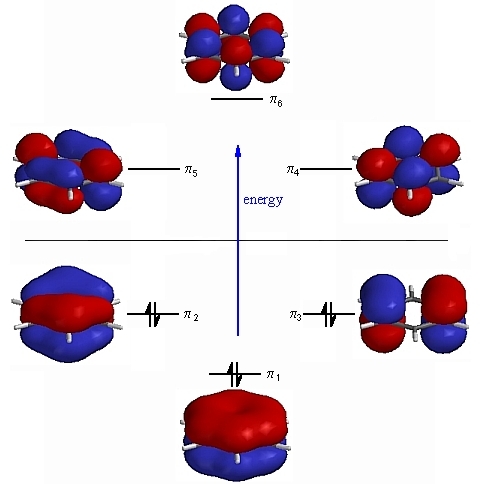
Well, this was supposed to be called the Molecular Orbital Theory, or MO Theory.
The goal of molecular orbital theory is to describe molecules in a similar way to how we describe atoms, that is, in terms of orbitals, orbital diagrams, and electron configurations.
Humph, I wonder how it will be done...
Orbital diagrams are usually drawn to make things easier to understand. :D

O2

O
These 2 pictures are actually diagrams for O2 and O. They are oxygen! :p
Each line in the molecular orbital diagram represents a molecular orbital, which is the volume within which a high percentage of the negative charge generated by the electron is found.
-The molecular orbitals are filled in a way that yields the lowest potential energy for the molecule.
-The maximum number of electrons in each molecular orbital is two.
-Orbitals of equal energy are half filled with parallel spin before they begin to pair up.
It can usually be found in this equation:

Isotopes!
Welcome back to the next series of Atoms! I really hoped you had fun in reading the previous post! Anyway, due to time constrain, I have fast forward the lesson to Isotopes!
So what exactly are Isotopes???? Hmmm...
Atoms of the same element can have different numbers of neutrons; the different possible versions of each element are called isotopes.
Refer to the previous post to recap on what is Neutron! :)
Hydrogen
The most common isotope of hydrogen has no neutrons at all; there's also a hydrogen isotope called deuterium, with one neutron, and another, tritium, with two neutrons.

You might now wonder how many Isotopes can 1 element have.
Well, sad to say that an atom cannot just have any number of neutrons. There are combinations of neutrons and protons, at which the forces holding nuclei together seem to balance best. Atoms with a few too many neutrons, or not quite enough, can sometimes exist for a while, but they're unstable.
So what is unstable in the above question?
Unstable atoms are radioactive: their nuclei change or decay by spitting out radiation, in the form of particles or electromagnetic waves.
Radioisotopes/ Radioactive Isotopes
That question above ^^^^^ leads me to the next topic, called radioisotopes!
It is well, sad to say that Radioisotopes are really really really (I mean really) dangerous.!!!
Because the like charges of the protons repel each other,there are always forces trying to push the atom nucleus apart. The nucleus is held together by something called the binding energy.
In most cases, elements like to have an equal number of protons and neutrons because this makes them the most stable. Stable atoms have a binding energy that is strong enough to hold the protons and neutrons together.

Even if an atom has an additional neutron or two it may remain stable. However, an additional neutron or two may upset the binding energy and cause the atom to become unstable.

In an unstable atom, the nucleus changes by giving off a neutron to get back to a balanced state. As the unstable nucleus changes, it gives off radiation and is said to be radioactive.

I'm sorry to say that the picture isn't clear, but I can tell you that it is giving out radioactive waves...Reminds me of the Bombing at Nagasaki. 0-0
Other facts

You'll get why I am showing you the Table :)
All elements with atomic numbers greater than 83 are radioisotopes meaning that these elements have unstable nuclei and are radioactive.
Elements with atomic numbers of 83 and less, have isotopes (stable nucleus) and most have at least one radioisotope (unstable nucleus).
As a radioisotope tries to stabilize, it may transform into a new element in a process called transmutation.
Uses of Radioisotopes
Shocking?!?!?! Yes, it can be used in medication you know! -Feign shock-
One major use of radioisotopes is in nuclear medicine. Of the 30 million people who are hospitalized each year in the United States, 1/3 are treated with nuclear medicine.
There are nearly one hundred radioisotopes whose beta and/or gamma radiation is used in diagnosis, therapy, or investigations in nuclear medicine. The most used radioisotopes were discovered before World War II.
So what exactly are Isotopes???? Hmmm...
Atoms of the same element can have different numbers of neutrons; the different possible versions of each element are called isotopes.
Refer to the previous post to recap on what is Neutron! :)
Hydrogen
The most common isotope of hydrogen has no neutrons at all; there's also a hydrogen isotope called deuterium, with one neutron, and another, tritium, with two neutrons.

You might now wonder how many Isotopes can 1 element have.
Well, sad to say that an atom cannot just have any number of neutrons. There are combinations of neutrons and protons, at which the forces holding nuclei together seem to balance best. Atoms with a few too many neutrons, or not quite enough, can sometimes exist for a while, but they're unstable.
So what is unstable in the above question?
Unstable atoms are radioactive: their nuclei change or decay by spitting out radiation, in the form of particles or electromagnetic waves.
Radioisotopes/ Radioactive Isotopes
That question above ^^^^^ leads me to the next topic, called radioisotopes!
It is well, sad to say that Radioisotopes are really really really (I mean really) dangerous.!!!
Because the like charges of the protons repel each other,there are always forces trying to push the atom nucleus apart. The nucleus is held together by something called the binding energy.
In most cases, elements like to have an equal number of protons and neutrons because this makes them the most stable. Stable atoms have a binding energy that is strong enough to hold the protons and neutrons together.
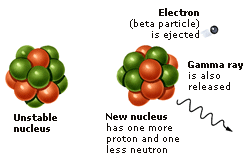
Even if an atom has an additional neutron or two it may remain stable. However, an additional neutron or two may upset the binding energy and cause the atom to become unstable.

In an unstable atom, the nucleus changes by giving off a neutron to get back to a balanced state. As the unstable nucleus changes, it gives off radiation and is said to be radioactive.

I'm sorry to say that the picture isn't clear, but I can tell you that it is giving out radioactive waves...Reminds me of the Bombing at Nagasaki. 0-0
Other facts

You'll get why I am showing you the Table :)
All elements with atomic numbers greater than 83 are radioisotopes meaning that these elements have unstable nuclei and are radioactive.
Elements with atomic numbers of 83 and less, have isotopes (stable nucleus) and most have at least one radioisotope (unstable nucleus).
As a radioisotope tries to stabilize, it may transform into a new element in a process called transmutation.
Uses of Radioisotopes
Shocking?!?!?! Yes, it can be used in medication you know! -Feign shock-
One major use of radioisotopes is in nuclear medicine. Of the 30 million people who are hospitalized each year in the United States, 1/3 are treated with nuclear medicine.
There are nearly one hundred radioisotopes whose beta and/or gamma radiation is used in diagnosis, therapy, or investigations in nuclear medicine. The most used radioisotopes were discovered before World War II.
Chemistry.....Atoms!
Wasssssssssssssup People! It's officially chemistry for this term! One last term before the EOYs! But anyway, I'm here to tell you more about atoms, and not here to make you depressed by telling you that the next term is the EOYs.
So anyway, let me give you a brief overview of the whole topic on Atoms...I guess. :)
So I'm sure you will ask, what are Atoms?
Before I start on anything official here, please do read up on elements. It will help you greatly in the first part, which is now. :)
All elements are made up of Atoms.
This picture below shows what scientists have found, the shape I mean.

The picture above shows the interior of an atom. Fasinating isn't it?
You might be wondering what are the headings there, and it's quite easy to understand actually.
The nucleus of an atoms consists of Protons, and Neutrons. Protons are POSITIVELY CHARGED, while Neutrons are NEUTRAL.
Electrons are the small little particles orbiting the nucleus. They are NEGATIVELY CHARGRED.
The picture below might actually help you! :)

However, if you have taken a good look at the periodic table, you are able to see that there are over a HUNDRED elements. And each element has a different number of neutrons, protons, and electrons.
Now, how do you know which number is the proton number (atomic number), and which is the mass number (made up of protons, and neutrons)?

So let me tell you again, if you didn't quite understand what I was talking about.
Mass Number
-Usually at the top left hand of the element box (right in this case)
-Made up of Protons, and Neutrons
Atomic Number
-Usually at the bottom left of the element box (right in this case)
-Number of Protons
Facts
You might have noticed that although it is the same element, the mass number is different, but it's not any typo error. There is a scientific explanation behind it. The element here is Carbon. In this case, carbon is in different proportions, and that is why the mass number is different, but it is still carbon in any case.
So anyway, let me give you a brief overview of the whole topic on Atoms...I guess. :)
So I'm sure you will ask, what are Atoms?
Before I start on anything official here, please do read up on elements. It will help you greatly in the first part, which is now. :)
All elements are made up of Atoms.
This picture below shows what scientists have found, the shape I mean.

The picture above shows the interior of an atom. Fasinating isn't it?
You might be wondering what are the headings there, and it's quite easy to understand actually.
The nucleus of an atoms consists of Protons, and Neutrons. Protons are POSITIVELY CHARGED, while Neutrons are NEUTRAL.
Electrons are the small little particles orbiting the nucleus. They are NEGATIVELY CHARGRED.
The picture below might actually help you! :)
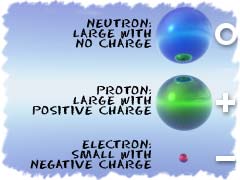
However, if you have taken a good look at the periodic table, you are able to see that there are over a HUNDRED elements. And each element has a different number of neutrons, protons, and electrons.
Now, how do you know which number is the proton number (atomic number), and which is the mass number (made up of protons, and neutrons)?

Mass Number
-Usually at the top left hand of the element box (right in this case)
-Made up of Protons, and Neutrons
Atomic Number
-Usually at the bottom left of the element box (right in this case)
-Number of Protons
Facts
You might have noticed that although it is the same element, the mass number is different, but it's not any typo error. There is a scientific explanation behind it. The element here is Carbon. In this case, carbon is in different proportions, and that is why the mass number is different, but it is still carbon in any case.
Saturday, May 9, 2009
coke and mentos
sorry for the late post on my group's coke and mentos.haven't been using computer recently.


this is the last picture of the whole collection.

actually, i took a lot more but it is redundant to show anyway so these are the few good pictures.hope you all like it and sorry for the late posting of it.
XD
frankly speaking, i don't know which of the follow is my group's photo so to my fellow group mates, sorry.if you want our group's photo, go see janelle's blog.(<-click there)
my group members: sarah,janelle,rachel, me
hypothesis:the more the amount of mentos, the higher the height of the mentos that shoots out.
result: GREAT!!!
things that went wrong:the mentos were stuck in the bottle so it won't come out and the disered ampunt of mentos that we wanted to put in was unfortunately changed.
such a pity for this picture below.could have taken the full photo but it all happened too fast for me to capture it. but i still love it.

this is the last picture of the whole collection.
actually, i took a lot more but it is redundant to show anyway so these are the few good pictures.hope you all like it and sorry for the late posting of it.
XD
frankly speaking, i don't know which of the follow is my group's photo so to my fellow group mates, sorry.if you want our group's photo, go see janelle's blog.(<-click there)
Sunday, May 3, 2009
DIET coke and mentos only.
wow!!!!!!!!!!
this video is so cool!
it seems as if they were holding a fountain parade. XD
but they tried the experiment a lot of times in order to achieve the result.
sorry if it did not show you why or how it actually works.
as in how the mentos reacts with the coke.
if you want to see, go rachel's blog.
it is showcased there.
this video is so cool!
it seems as if they were holding a fountain parade. XD
but they tried the experiment a lot of times in order to achieve the result.
sorry if it did not show you why or how it actually works.
as in how the mentos reacts with the coke.
if you want to see, go rachel's blog.
it is showcased there.
paper chromatography
this is another video by me today.
This is the first one. The bottom one is the rectangle chromatography paper. Some parts of it is fast-forward so it may look very wierd. And the liquid that is poured into the tube is not water but ethonal . they did draw the line but they used permarnent marker instead of pencil and thus, don't need to add the ink. the colours that is shown is unlike ours which is like 1 line but theirs filled up the whole paper and the colours are totally different from the start. o.olll
ENJOYENJOYENJOY
This is the first one. The bottom one is the rectangle chromatography paper. Some parts of it is fast-forward so it may look very wierd. And the liquid that is poured into the tube is not water but ethonal . they did draw the line but they used permarnent marker instead of pencil and thus, don't need to add the ink. the colours that is shown is unlike ours which is like 1 line but theirs filled up the whole paper and the colours are totally different from the start. o.olll
ENJOYENJOYENJOY
lab safety rules
this is just a short clip about lab safety and what would happen to you if you do not follow it. (if you could consider it short) maybe you can really hear this first clip well so i posted a new one which is bellow.
i just realised that all the videos are all black and white. 0(>.<)0
Tuesday, April 21, 2009
seperating mixtures
how to seperature sand from a mixture?

-> actually it depends on what the mixture is. if it were sand and water, we could just use a filration paper or just boil the water till the water evaporated, leaving only the sand behind.
or another example is separating sand from a mixture dirt.Take 100 ml beaker, pour the mixture, and stir with a stirring rod 10- 15 minutes. Once done, let the beaker to stand for 20-30 minutes. as time goes you will see the different layer in the beaker with sand at the bottom of beaker as it is heavier than dirt and then a layer of dirt on it.
iron + mixture?
-> you can use a strong magnet to attract the iron as the iron is magnetic.
solid + mixture?
-> 4 methods are commonly used for seperating mixtures from solids.
-> 4 methods are commonly used for seperating mixtures from solids.
1.filtering
2.evaporating
3.crystallizing
4.Centrifuging
4.Centrifuging
This is evaporation .
for the rest so sorry, can't find pictures.
air + mixture
->lets say that the mixture is water. in this case, we are able to use a separating funnel as petrol which acts like oil, floats on water.
sorry for the drip drop information. can't find anything about it. o-O
Tuesday, April 7, 2009
elements part 3
i have found other types of periodic table. there are circular table and helical tables that is better than the mundane rectangle-ish table. i wonder how they group the elements. i think it is the same. anyway, this is the circular periodic table.


this is the helical table. i personally dislike this table as it is very messy.i think that the rectangle periodic table really helps us to understand better as i think we are more acostomed to the rectangle table.

oh this is the chinese periodic rable. each letter represents an element.

Monday, April 6, 2009
continue from elements
these questions could be found on the academic portal, at the announcements.
1.Is the version of the Periodic Table we're using the ONLY version?
Ans: there should be more than 1 type of periodic table as maybe some people do not know how to speak, for instance, english, so it would come in many language, but maybe that is not the main point. there should be other ways of grouping the elements in the table. but maybe as years progresses, the periodic table might expand and who knows, maybe somebody great would again simplify the table? but again, there would be a lot more new elements that would be added into the periodic table and there might be chance that the table would not be simplified but instead, become larger?? :)
2.How do scientist in other parts of the world come to a common understanding about the elements?
Ans:wow! that is a very difficult question to answer. it seems that maybe scientist just find the elements by themselves and maybe get together to provide their findings? or maybe, one scientist tell other scientist as you/we cannot work alone.as the saying goes, no man is an island, so they discuss with each other and the message goes on and on....that is just what i think only. arghhh.can't find but this should be it.
1.Is the version of the Periodic Table we're using the ONLY version?
Ans: there should be more than 1 type of periodic table as maybe some people do not know how to speak, for instance, english, so it would come in many language, but maybe that is not the main point. there should be other ways of grouping the elements in the table. but maybe as years progresses, the periodic table might expand and who knows, maybe somebody great would again simplify the table? but again, there would be a lot more new elements that would be added into the periodic table and there might be chance that the table would not be simplified but instead, become larger?? :)
2.How do scientist in other parts of the world come to a common understanding about the elements?
Ans:wow! that is a very difficult question to answer. it seems that maybe scientist just find the elements by themselves and maybe get together to provide their findings? or maybe, one scientist tell other scientist as you/we cannot work alone.as the saying goes, no man is an island, so they discuss with each other and the message goes on and on....that is just what i think only. arghhh.can't find but this should be it.
Friday, April 3, 2009
elements song
this is the link for the elements song:
http://www.privatehand.com/flash/elements7.swf
if you want to know what is the first 20 elements of the periodic table, read on. frankly speaking, i find the names too ridiculous to believe. it sounds too alien and majority of the names are like too impossible to pronounce. ireally wonder how the man who sung the song was able to pronounce the words and sang them in estimated one breath.
if i am not wrong, this should be the first 20.
1.hydrogen (H)
2.helium (He)
3.lithium (Li)
4.beryllium (Be)
5.boron (B)
6.carbon (C)
7.nitrogen (N)
8.oxygen (O)
9.fluorine (F)
10.neon (Ne)
11.sodium (Na)
12.magnesium (Mg)
13.aluminium (Al)
14.silicon (Si)
15.phosphorus (P)
16. sulphur (S)
17.chlorine (CI)
18.argon (Ar)
19.potassium (K)
20.calcium (Ca)
link for the lyrics:
http://www.ncl.ox.ac.uk/talkweb/elements.html
gosh, it sounds so funny!
just to show you the periodic table.
http://www.privatehand.com/flash/elements7.swf
if you want to know what is the first 20 elements of the periodic table, read on. frankly speaking, i find the names too ridiculous to believe. it sounds too alien and majority of the names are like too impossible to pronounce. ireally wonder how the man who sung the song was able to pronounce the words and sang them in estimated one breath.
if i am not wrong, this should be the first 20.
1.hydrogen (H)
2.helium (He)
3.lithium (Li)
4.beryllium (Be)
5.boron (B)
6.carbon (C)
7.nitrogen (N)
8.oxygen (O)
9.fluorine (F)
10.neon (Ne)
11.sodium (Na)
12.magnesium (Mg)
13.aluminium (Al)
14.silicon (Si)
15.phosphorus (P)
16. sulphur (S)
17.chlorine (CI)
18.argon (Ar)
19.potassium (K)
20.calcium (Ca)
link for the lyrics:
http://www.ncl.ox.ac.uk/talkweb/elements.html
gosh, it sounds so funny!
just to show you the periodic table.

Tuesday, March 31, 2009
disasters
Can we stop disasters from happening?
Supposing the answer from me would be no and maybe on second thoughts yes.
Examples of we can't stop disasters from happening:
1.hurricane
2.typhoon
3.tornado
4.flood
Examples of we can stop disasters from happening:
1.soil erosion(cutting of trees)
2.burning of forest(haze that were caused by people)
on third thoughts, the second examples of we can stop disasters from happening. Maybe there are not even diasaters at all except no.1 that said soil erosion...maybe.
~excess~wow! published so many post today! so tired so i hope you would have fun with it! chaosss.
Supposing the answer from me would be no and maybe on second thoughts yes.
Examples of we can't stop disasters from happening:
1.hurricane
2.typhoon
3.tornado
4.flood
Examples of we can stop disasters from happening:
1.soil erosion(cutting of trees)
2.burning of forest(haze that were caused by people)
on third thoughts, the second examples of we can stop disasters from happening. Maybe there are not even diasaters at all except no.1 that said soil erosion...maybe.
~excess~wow! published so many post today! so tired so i hope you would have fun with it! chaosss.
if i were to built a building.
If I were to build an even taller building, what materials will I choose and why. Frankly speaking, I never want to be an engineer. I would rather be an architect but anyway, back to the topic. I would have to consider where I want the building to be build at and the space limited, the climate. But lets assume the climate is good, there are plenty of space etc but all in good condition. I would use steel, cement, bricks, maybe a little of wood. I would want the building to be strong, and long-lasting, but of course pleasant to the eyes too!
materials used to build tall buildings
The materials used for the structural system of high-rise buildings are reinforced concrete and steel. Most American style skyscrapers have a steel frame, while residential tower blocks are usually constructed out of concrete.
reinforced concrete: concrete in which reinforcement bars or fibers have been incorporated to strengthen the material that would otherwise be brittle.
Why are these materials suitable?(steel and concrete)
Steel and concrete must always be together when building tall buildings as when building, the steel they use are normally hollow so in order to make the steel stronger, concrete is used to fill in the hole. After which, the concrete would harden and thus, making the object stronger and more durable. Steel and concrete are hard, strong, durable. They are able to withstand the weight of the building.
So i assume that the foundation of the building is heavier? Because the building must have the support.
Would you use the same materials to build other buildings?
I think that majority of the buildings that were built were made with steel and concrete so they would stay still at all cost. However, in Japan due to the earthquake that happen regularly there, the houses are made of wood so when it tumbles, the impact would not be so great. It depends on the environment and the weather etc. If there are terrible disasters going on there, the best material should be wood, but strong wood.
Before Sep 11, 2001 incident, how was the World Trade Centre being viewed? A mighty building that cannot be destroyed?
Instead of having the same building structures as the other buildings that were built before,it had a load-bearing perimeter steel columns called Vierendeel trusses that were spaced closely together to form a strong, rigid wall structure, supporting virtually all lateral loads such as wind loads, and sharing the gravity load with the core columns and thus, making it stronger than other buildings. Although it was one of the most well-known buildings, it had criticisms as well. A small group of business were affected and many residents, tenants etc resisted force relocation of the center as well.
reinforced concrete: concrete in which reinforcement bars or fibers have been incorporated to strengthen the material that would otherwise be brittle.
Why are these materials suitable?(steel and concrete)
Steel and concrete must always be together when building tall buildings as when building, the steel they use are normally hollow so in order to make the steel stronger, concrete is used to fill in the hole. After which, the concrete would harden and thus, making the object stronger and more durable. Steel and concrete are hard, strong, durable. They are able to withstand the weight of the building.
So i assume that the foundation of the building is heavier? Because the building must have the support.
Would you use the same materials to build other buildings?
I think that majority of the buildings that were built were made with steel and concrete so they would stay still at all cost. However, in Japan due to the earthquake that happen regularly there, the houses are made of wood so when it tumbles, the impact would not be so great. It depends on the environment and the weather etc. If there are terrible disasters going on there, the best material should be wood, but strong wood.
Before Sep 11, 2001 incident, how was the World Trade Centre being viewed? A mighty building that cannot be destroyed?
Instead of having the same building structures as the other buildings that were built before,it had a load-bearing perimeter steel columns called Vierendeel trusses that were spaced closely together to form a strong, rigid wall structure, supporting virtually all lateral loads such as wind loads, and sharing the gravity load with the core columns and thus, making it stronger than other buildings. Although it was one of the most well-known buildings, it had criticisms as well. A small group of business were affected and many residents, tenants etc resisted force relocation of the center as well.
Friday, March 27, 2009
bio hazardous and toxic
Definition of bio hazardous:
an organism or substance derived from an organism that pose threat to human health or animals.
Definition of toxic:
It is a poisonous substance produced by living cells or organism.
my thoughts:
i think it is almost the same as toxic is included as one of the category for bio hazardous. Both poses a threat towards human or animal. It is also a substance derived from an organism.
i have looked at joyi's blog and she stated that toxic would cause people lives but biohazardous do not harm people.
an organism or substance derived from an organism that pose threat to human health or animals.
Definition of toxic:
It is a poisonous substance produced by living cells or organism.
my thoughts:
i think it is almost the same as toxic is included as one of the category for bio hazardous. Both poses a threat towards human or animal. It is also a substance derived from an organism.
i have looked at joyi's blog and she stated that toxic would cause people lives but biohazardous do not harm people.
Alaska volcano Mt Redoubt
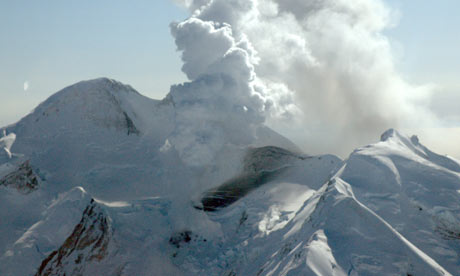
Mt Redoubt
Alaska's Mount Redoubt volcano erupted five times overnight, sending an ash plume more than 9 miles into the air in the volcano's first emissions in nearly 20 years. Residents in the state's largest city were spared from falling ash, though fine gray dust fell Monday morning on small communities north of Anchorage.
Ash from Alaska's volcanos is like a rock fragment with jagged edges and has been used as an industrial abrasive. It can injure skin, eyes and breathing passages. The young, the elderly and people with respiratory problems are especially susceptible to ash-related health problems. Ash can also cause damage engines in planes, cars and other vehicles.
The first eruption, in a sparsely populated area across Cook Inlet from the Kenai Peninsula, occurred at 10:38 p.m. Sunday and the fifth happened at 4:30 a.m. Monday, according to the Alaska Volcano Observatory.
The past eruptions of Redoubt indicate the volcano could erupt again in the next few days or weeks. It is something we need to be prepared for.
Alaska's Mount Redoubt volcano erupted five times overnight, sending an ash plume more than 9 miles into the air in the volcano's first emissions in nearly 20 years. Residents in the state's largest city were spared from falling ash, though fine gray dust fell Monday morning on small communities north of Anchorage.
Ash from Alaska's volcanos is like a rock fragment with jagged edges and has been used as an industrial abrasive. It can injure skin, eyes and breathing passages. The young, the elderly and people with respiratory problems are especially susceptible to ash-related health problems. Ash can also cause damage engines in planes, cars and other vehicles.
The first eruption, in a sparsely populated area across Cook Inlet from the Kenai Peninsula, occurred at 10:38 p.m. Sunday and the fifth happened at 4:30 a.m. Monday, according to the Alaska Volcano Observatory.
The past eruptions of Redoubt indicate the volcano could erupt again in the next few days or weeks. It is something we need to be prepared for.
tallest building in Singapore
 Tallest building
In Singapore, 3 buildings share the same name for the tallest building in Singapore, namely UOB Plaza One, Republic Plaza and UOB Centre. These 3 buildings are 280m in height. Can you imagine how tall is that? The Civil Aviation Authority of Singapore only permits the building to be built up to a maximum height of 280m due to aviation reasons. As technology is slowly improving, maybe there would be a higher building in the future!!

Tallest hotel in Singapore.
The tallest hotel in Singapore is the Swissotel. There are 1,261 guestrooms and luxury suits with 16 bars,restuarants etc. You are able to enjoy a paranomic view os Singapore, Malaysia and Indonesia from Southeast Asia's tallest hotel. As there are limited spaces in Singapore, the hotel can only be built upward and not sideways.

Tallest building in the world
The tallest building till now is Burj Dubai. It is 818m in height and has 160 floors. Burj Dubai is normally compared to other buildings and the difference betweent the second tallest and Burj Dubai is around 200m. Imagine the difference! It sure must have a strong foundation. Sometimes i don't understand why the contracters must build the building till so high.
Subscribe to:
Posts (Atom)